You did not draw it. You are still held to it.
The only bar that catches anything is the one with no room left.
Document review for estimating
Review the bid documents before you price the work.
Setmark supports the first pass through construction documents. For an estimating team, the question is practical: what deserves a second look before it reaches the estimate? Your estimator keeps responsibility for interpretation, pricing and the final bid.
Start with your review process
Tell us your trade, the kind of projects you bid and where document review slows you down. For a project walkthrough, agree on the document package and checklist with us before sharing files.
Inspect the evidence and the gaps
Use the walkthrough to compare a first pass with your own review. Look at what it caught, what it missed and what still needed an estimator. Confirm the output and its limits for your kind of work.
Check the next step into your estimate
Name the estimating software you use. Check how reviewed information would reach it: a demonstrated connection, a file handoff or manual entry. Confirm that path during the evaluation.
Evaluate where document review belongs in your estimate.
Five questions a useful walkthrough should answer:
1. What documents can the workflow accept?
The required files, drawing revisions, supported conditions, and exclusions.
2. Where does each finding come from?
A source reference that the estimator can inspect in context.
3. What still needs a decision?
Unresolved information and the person responsible for reviewing it.
4. How does approved information move?
The actual connection, file handoff, or manual step, including what carries through.
5. Who owns pricing and approval?
Your estimating team's responsibility for the final estimate and bid.
Fit depends on your documents, trade and review process. The walkthrough is where we establish the supported scope and handoff before you rely on either in a live bid.
Discuss your estimating workflowYou are pricing plans drawn by an office you have never worked with.
The bid is due Friday. Nobody is paying you to learn how this office draws.
Ten things that eat at your time that nobody has time for.
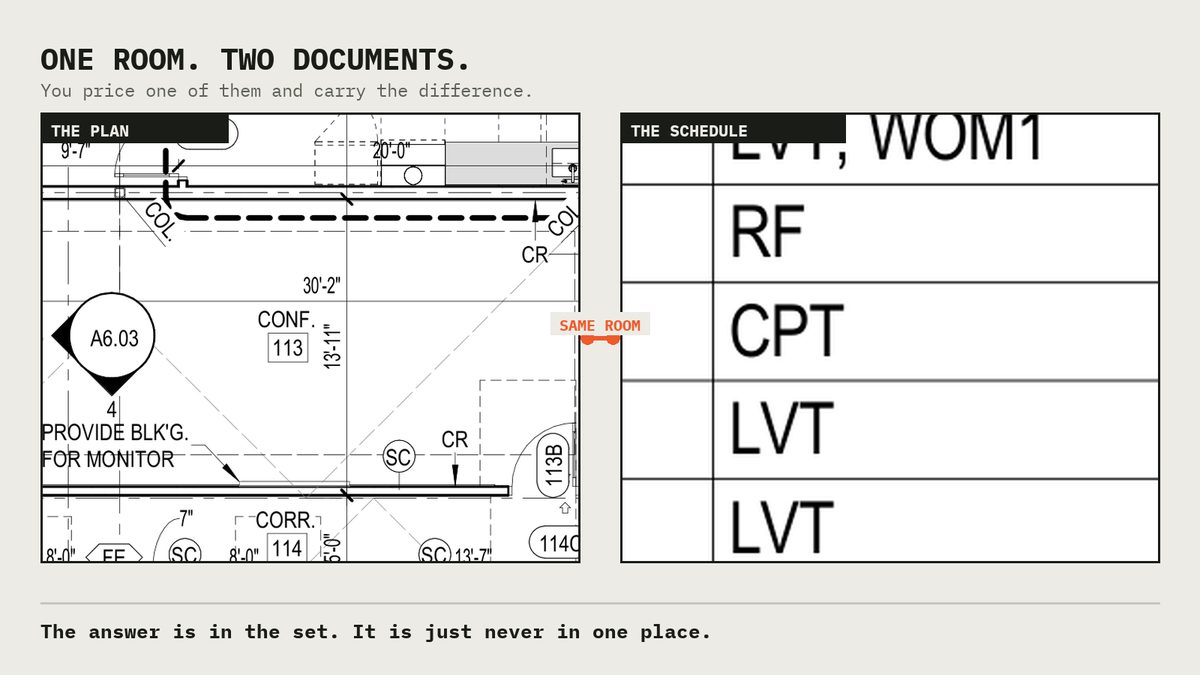
The plan says one thing. The schedule says another.
Same room, two answers, and you have to price one of them. It is the single most common question asked of an architect during bidding, which tells you both how often it happens and how rarely it gets settled before your number is due.
Nothing tells you which one wins. Not until after you have the job.
The standard contract calls the drawings and the specifications complementary and leaves it there. Federal work puts the specs on top. Another contract family puts them on top only within a tier. So the same conflict resolves differently depending on a document you will not see until after award.
You find it the day before the bid. Clarification takes longer than that.
You are required to ask before bidding, and the questions do not surface until you are far enough into the take-off to see them, which is the day before or the morning of. So you price your best reading and quietly carry the difference.
By others. Two words that move your scope.
A note meant as a coordination hint gets read as a boundary, and the item lands in the gap between you and whoever else assumed it was theirs. Your own exclusion letter will not save you either. If the item is on the drawings you bid, the drawings usually win.
The bid that says nothing is the one that levels lowest.
Write your exclusions out plainly and you look expensive next to the man who stayed quiet and collects the change order in month four. Being clear is a competitive disadvantage, right up until the day the job starts.
You cannot price the walls until you have priced the ceilings.
How high you board and finish a wall depends on the ceiling above it, so the ceiling take-off has to come first, off a different sheet. Half the quantities in a package are locked behind a quantity that lives somewhere else in it.
Addendum three lands Thursday. You took that sheet off on Monday.
A sketch changes the exact sheet you already measured. And underneath that sits the older trap, which is being handed a stale set to bid and then held to the current one. It is why a careful bid names the drawing date and lists every addendum it actually used.
The scope is all there. It is just not in one place.
Some on the drawings, some in the spec book, some in the addenda. And the parts that cost the most are the least visible. Whether a wall is rated, how many layers it takes, whether it runs all the way to the deck. None of that is on the plan. It is in a detail.
Every office draws differently. Nobody teaches you theirs.
The graphic language gets picked up by osmosis and everybody assumes you already have it. So the first hours on an unfamiliar package go to working out how this firm says things, before a single quantity is measured. Nobody pays for those hours and they recur with every new relationship.
Drawn as performance only. The engineering is now yours.
The sheet describes what the assembly has to do rather than what it is, and the design quietly moves into your bid without ever becoming a line item. You are pricing engineering you have not done, off a drawing that does not admit it is asking for any.
We would rather show you than tell you.
Setmark reads the documents first and pins what deserves a second look, so the hours your reviewer does have go to judgment instead of hunting for the detail that just says SIM.
You cannot buy more week. You can stop spending it on the first pass.
Send one project you have already redlined, with the checklist your office already uses. We run it against yours, not a generic one, and put the two side by side, so you can see what the first pass would have handed you.
Book a walkthroughThirty minutes, on your own drawings. You see what it caught, what it missed, and what still needed you. If it is not useful on your kind of work yet, we say so and you are out half an hour.