The drawings leave on Friday. The check never got a slot.
The only bar that catches anything is the one with no room left.
Your reviewer never had enough time.
The project finishes on Thursday. The client wants revisions by Monday.
Ten things that eat at your time that nobody has time for.
Anyone can draw it. Nobody has an hour to check it.
The long hours are already being worked, and most of them are not being paid for. There is no spare evening left to find. So the check does not lose an argument about priorities, it just never gets a slot. Do it perfectly and the reward is that nothing happens.
Five days, every one already committed to work somebody is paying for.
The review needs a day. There is no day. It hovers, looking for somewhere to land.
On top of the week, unpaid, after hours. Which is the same as not happening.
The people who used to check were the ones let go.
When work dried up, firms kept principals and kept juniors. The layer in the middle, the ten to fifteen year people carrying the construction judgment, was the one that got cut, and nobody rebuilt it. So there is now very little between the person who drew it and the person whose name goes on it.
Principals on top, the ten to fifteen year layer under them, juniors at the base.
The middle is removed. It was the most expensive layer and the least visible one.
Nothing. The drawing now goes straight from the person who made it to the seal.
Three days to review it. The redlines land after it ships.
Nobody pencils down before the due date, so the drawings handed over for review are the same prints already going out. The package arrives seventy percent done and labeled ninety, and the window closes after the issue date. Every note in the review is correct. Not one of them can change anything.
Review sits before the issue date, which is the only place it can do any work.
Drawing runs to the deadline. The set going out for review is the set going out.
All correct, all landing on the far side of the gate, where nothing can change.
Asking for a check looks like you cannot do the job.
In plenty of offices, needing your drawings redlined is quietly treated as a performance problem. Requires a lot of hand holding. So the people who most need a second pair of eyes are exactly the ones who learn to stop asking for one.
One person puts a hand up and asks for a second pair of eyes on their sheets.
It does not read as diligence. It goes in the file as needing hand holding.
Nobody asks again. The check is still on the table and nobody will touch it.
Nobody can bill for checking. So nothing in the fee pays for it.
It is not a phase, not a deliverable, and it has never once appeared as a line on a proposal, while design fees have been getting squeezed for years. And the office is not quiet, it is flat out, which is exactly why nobody has stopped to fix any of this.
Every phase on a proposal is something that can be named, drawn and invoiced.
The same phases, thinner every year. The work inside them did not shrink.
Checking has no slot to be squeezed out of, because it was never in one.
Everyone has standards. No two of them match.
Your office has its own way of laying out construction documents, naming sheets and tagging things, and so does everybody you send it to. They all learn yours from scratch before they can read a single sheet. Nobody bills you for that hour. You pay it anyway, every time. And everyone involved believes theirs is the reasonable one.
Each internally consistent, and each certain that theirs is the reasonable one.
Nothing lines up, because none of it was ever meant to line up with anything else.
An hour learning yours before a single sheet can be read. Unbilled, every time.
The rule that stops you is not in the code book.
What you can defer, what has to be shown up front, what the reviewer will bounce it for. Decided city by city, and written down somewhere you are not looking. The city does not publish the rule. The city publishes a comment.
The adopted code, the amendments, the bulletins. All public, and all of it read.
Outside the stack entirely. Held by one department, in one city.
It arrives as a comment, which is the first time it was ever written down.
The code moves. The client moves. Every week.
Each change has to land in every place the documents already said the old thing, and those places are scattered across plans, schedules, details and notes. Nobody finds all of them, every time, on every project. The ones you miss look exactly like the ones you caught. There is already a note that covers this. It says VERIFY IN FIELD.
One decision, written into plans, schedules, details and notes.
Most get updated. Some do not. Nobody holds a list of which is which.
A missed one and a caught one look identical. There is no mark for it.
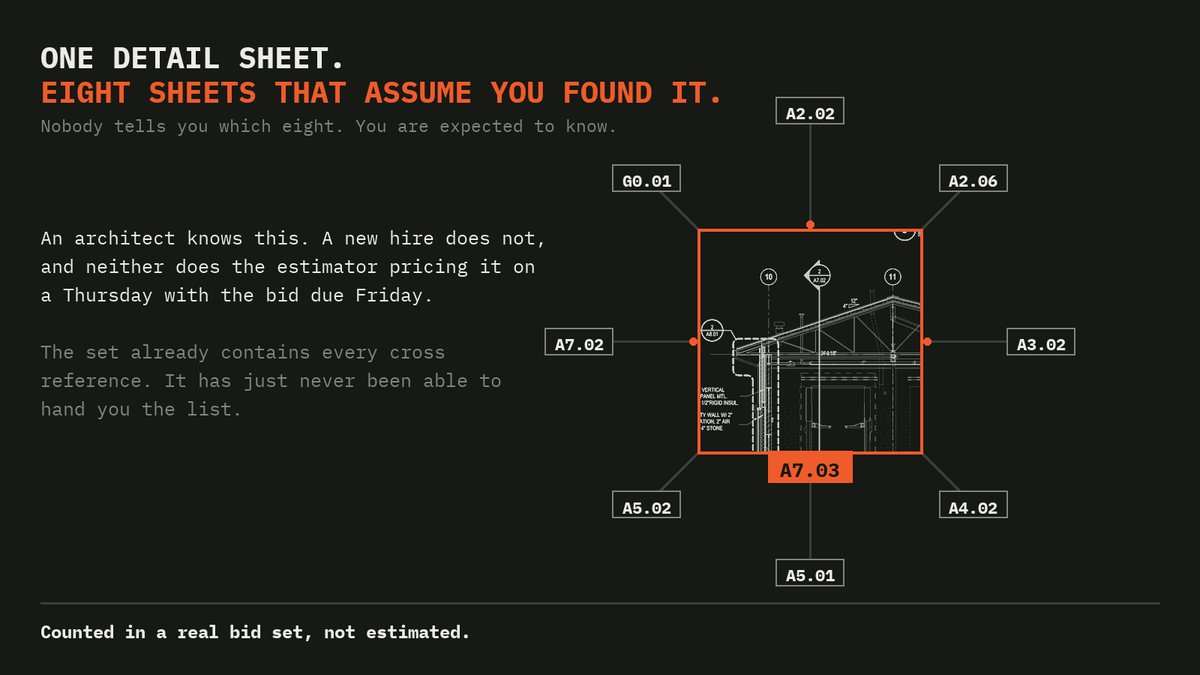
One thing. Three names. Three sheets.
The same assembly gets called something different on the plan, in the schedule and on the detail, and every one of those was right when somebody typed it. Downstream that is three items to price, or one item priced three times.
A single thing, specified once, and entirely correct.
Plan, schedule, detail. Three names, each right when it was typed.
Three items to price, or one item priced three times. Both are wrong.
You will not find out at submittal. You will find out on site.
Sometimes years on. By then it is not a redline. It is a change order, a delay, a call with your insurer, and a room of people finding out whose drawing it was. It is always in the drawings. That is the whole problem with drawings.
Small, buried, and indistinguishable from everything around it.
It gets built over. Every layer above assumes the one under it was right.
It surfaces at full size, in front of everybody, with a cost attached.
We would rather show you than tell you.
Setmark reads the documents first and pins what deserves a second look, so the hours your reviewer does have go to judgment instead of hunting for the detail that just says SIM.
You cannot buy more week. You can stop spending it on the first pass.
Send one project you have already redlined, with the checklist your office already uses. We run it against yours, not a generic one, and put the two side by side, so you can see what the first pass would have handed you.
Book a walkthroughThirty minutes, on your own drawings. You see what it caught, what it missed, and what still needed you. If it is not useful on your kind of work yet, we say so and you are out half an hour.