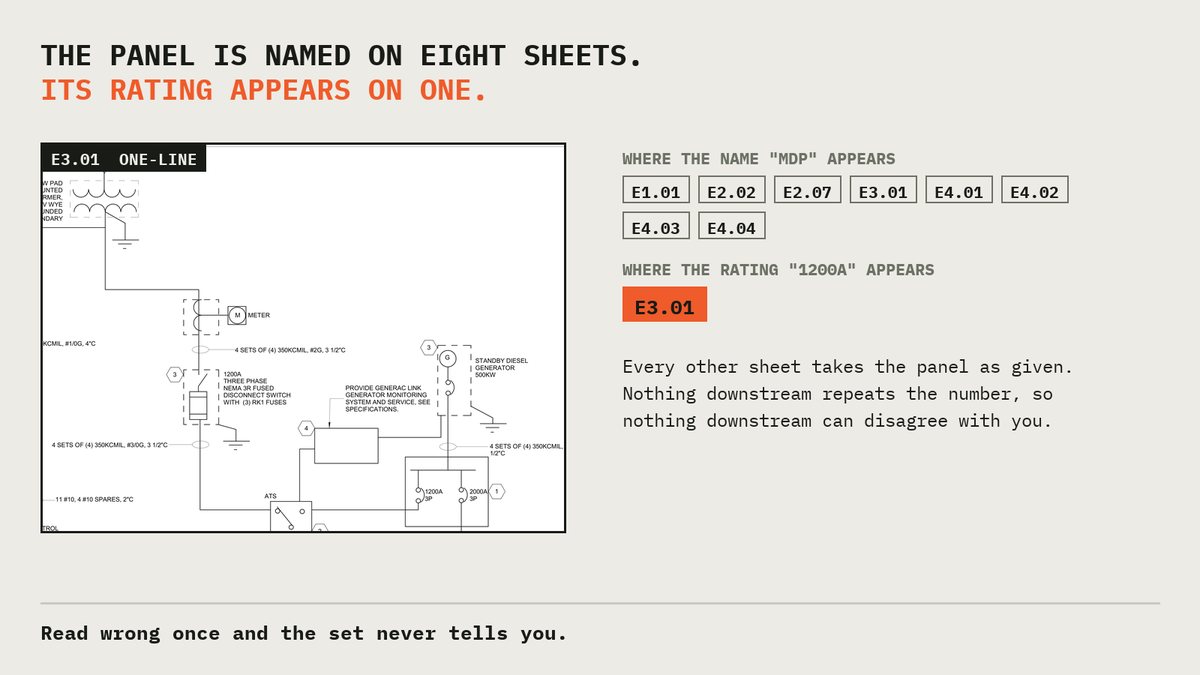
One drawing carries the number. Nothing else repeats it.
If that one line is wrong, nothing in the set disagrees with it.
The comment costs a week. The drawing change costs an hour.
The package gets sealed Friday. The only person who could have checked it is the person who sealed it.
Ten things that eat at your time that nobody has time for.
The QA step is in the process. It is not in the week.
Engineers describing their own offices say that in practice almost nothing gets checked, and that this is not a decision anybody made. It is how the business runs. A realistic figure for work that gets a genuine independent check is a small fraction of what goes out the door.
The fee does not allow for checking. It barely allows for designing.
Checking is the first thing cut when a fee gets squeezed, ahead of anything in the design itself, because it is the only line that produces nothing a client can see. Nobody defends it, because there is nothing to point at.
The person who could check it is catching their own mistakes.
The qualified reviewer is carrying the same production load as everybody else, on their own deadlines. Checking somebody else is what happens after their own work is safe, which is a moment that does not arrive.
A check that reads your calcs inherits your blind spot.
A real check is done without the original calculations in front of you, because a logical error that made sense to the author tends to make sense to the reviewer following along behind them. Almost nobody works that way. So the arithmetic gets verified and the premise does not.
The seal makes it legal. It does not make anybody read it.
Reviewing a package after somebody else prepared it does not meet the definition of responsible charge, and it is the workflow most offices run. Where checking does survive reliably, the reason given is an outside audit regime, not the license.
You check it, you own it. Including the parts you did not read.
The engineer who checks a drawing carries the final responsibility whether or not they specifically checked that item, and the person who drew it does not. So the checker role is a liability position with no fee attached to it, which is a strong reason to never be named as one.
Stamp this. I already drew it.
Seal the preliminaries as final. Seal the sheets you did not draw. Seal it while the boss is out, the firm carries insurance. It does not, the license is yours personally. There is a standing ethics case for each of those, which is how you know how routinely they get asked.
Nothing tells you the background moved.
The link refreshes when a person remembers to repoint it. Miss that once and you keep drawing on geometry that was superseded weeks ago, with no warning anywhere in your own file. It surfaces at the next full overlay, or on site.
See structural drawings. The note that is not coordination.
A conflict found after the first pass, answered with a cross reference instead of a resolution. It reads like coordination and behaves like a handoff, and the person who finally settles it is the contractor, in an RFI.
Two disciplines, both current. No way to prove it.
Some firms revise by project and some revise by sheet. So two consultants can each be correct about their own revision level, be drawing different buildings, and have nothing in either set that would reconcile them.
We would rather show you than tell you.
Setmark reads the documents first and pins what deserves a second look, so the hours your reviewer does have go to judgment instead of hunting for the detail that just says SIM.
You cannot buy more week. You can stop spending it on the first pass.
Send one project you have already redlined, with the checklist your office already uses. We run it against yours, not a generic one, and put the two side by side, so you can see what the first pass would have handed you.
Book a walkthroughThirty minutes, on your own drawings. You see what it caught, what it missed, and what still needed you. If it is not useful on your kind of work yet, we say so and you are out half an hour.